
Malta's Famous-Fortifications
Malta's fortifications are considered to be among the best examples of military architecture anywhere in the world.
- The vast majority of Malta's fortifications were built as a defence against Cannon & built by the Knights of Malta when they arrived on Malta in 1530 after there defeat by the Ottomans on Island of Rhodes
- The Knights of the Order of Saint John made Birgu, their central location. Now Birgu is in the middle peninsular of what is called the Three Cities, Vittoriosa, Senglea, and Cospicua
- The Knights then constructed Fort Saint Angelo on the tip of the peninsular facing The Grande Harbour
- This fort was built on the site of Castrum Maris (Castle by the sea) of unknown age possible Arab in 870AD or in the Middle ages when it appeared in records.
- 10 years later the land approach defences were constructed
The Art of protection against Cannon
The Art of protection against Cannon
With the introduction of cannon the medieval castle became almost undefendable. The high tall fairly narrow walls were easily brought down by cannon balls.
The result:
- Walls were built much lower only a little above the ground level on the outer side of the ditch, providing a small target for Cannon balls.
- A very deep ditch in front of the wall maintained a height to make scaling difficult
Fortification Terminology
Bastion
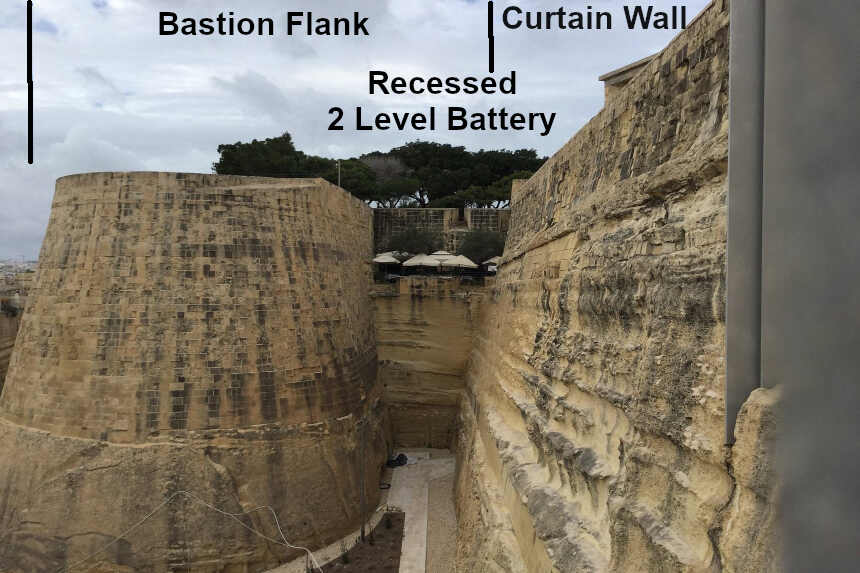
Rounded & recessed Flank of St. Johns Bastion
- Built at the corner of a fort & have two faces and two flanks.
- They are the replacement of the of the Medieval Castle Towers,whose height was it's week point in the age of cannon
- They were therefore much shorter, usually the same height as adjacent curtain walls Bastions extend outwards beyond the curtain wall which allows the defenders of the fort to cover adjacent bastions and curtain wall with defensive fire.
- The design ensured that there was no blind spot at the foot of the walls
- Normally the flanks of bastions are flat but in Malta most of them are shorter & rounded, with a recessed flat section of the flank at right angle &s against the curtain wall with position for 2 or 3 cannon on 2 levels that could fire along the curtain wall & were also invisible to the enemy.
- A Demi-Bastion is a small bastion that doesn't’t have both faces or both flanks.
Cavalier
- A higher cannon platform placed behind a Bastion that could fire over the bastion giving supporting fire
- Usually 5 sided
Embrasure
- Aperture in the parapet to allow fora cannon position.
Face
- Side of the bastion exposed to the enemy.
Flank
Part of the bastion between the curtain wall and the face, making it possible to fire along the curtain wall, & the face and flank of face of the neighbouring bastionCaponiere
- A low level firing position built into the ditch with loopholes to fire along the length of the ditch.
- To protect the Caponiere the ditch is often dug deeper in front of it.
Couterscape Gallery
- Has the same purpose as a Caponiere but is built into the outer wall of the ditch near a corner of the ditch.
- Access to the Gallery is via a tunnel from inside the fortification and under the ditch.
Demilune
Freestanding triangular fortification placed in front of a curtain wall and having a firing surface.
Ditch
- Ditches were dug deeper to provide more height to the walls
- The soil & Stone dug out of the ditch was spread out on the ground in front of the ditch making a sloping rise with the highest location of the rise being the edge of the ditch. This had a threefold effect.
- It made the ditch deeper.
- It provided an earthen barrier in front of the wall and hideing most of the wall'
- Defenders cannon fire was at the correct height to directly fire d ow the entire slope , called a glacis, making it a killing zone
Parapet
- A Parapet was a wall that protected defenders on the walkway of the curtain walkway or defensive structure.
- It was usually at least a metre thick.
- Instead of the medieval castle type of battlements of merlons the high part for protection & the low part for firing arrows, you have embrasures, a lower portion of the wall for a cannon position.
Postern Gate
- A discreetly positioned, often semi hidden from the enemy, small gateway built into a rampart.
Tenaille
- Fortification made up of two faces forming an angle opening inward, placed in front of the curtain wall and designed to shield i from cannon fire.
Terreplein
- Horizontal surface of a defensive position such as the roof of a a bastion or designed to accommodate the artillery.